New paper · Arc Institute / NVIDIA
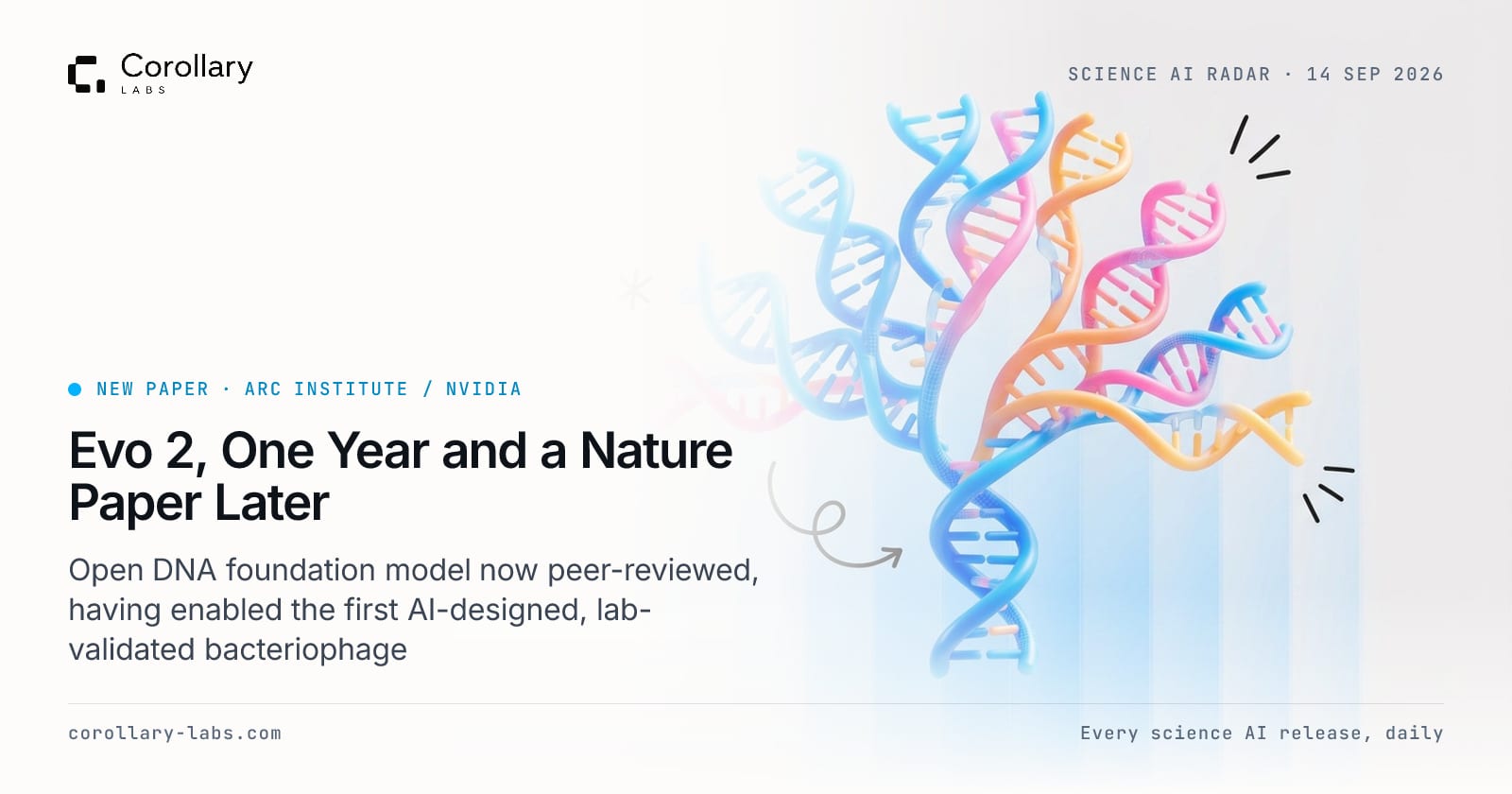
Evo 2, One Year and a Nature Paper Later
Open DNA foundation model now peer-reviewed, having enabled the first AI-designed, lab-validated bacteriophage
· 15 claims checked against 5 sources
What it is
Evo 2 is a genome-scale DNA foundation model developed by Arc Institute and NVIDIA, with collaborators at Stanford University, UCSF, UC Berkeley, Goodfire and the University of Washington. Released as a preprint in February 2025, it has now cleared peer review and been published in Nature.
How it works
The model is trained on 9.3 trillion nucleotides drawn from the DNA of more than 100,000 species across all domains of life. It uses the StripedHyena 2 hybrid architecture, which combines convolutional and attention layers, giving it a 1-million-token context window and letting it be trained on 30 times more data than its predecessor, Evo 1.
What is new
Several results have emerged since the preprint:
- Fine-tuning Evo 2 on ΦX174-like bacteriophage genomes produced 16 of 285 designs that propagated and inhibited target bacteria with no off-target activity, the first AI-designed and experimentally validated organism.
- Zhu et al. found Evo 2 scores on APOE variants track Alzheimer's disease risk when combined with ADNI and UK Biobank cohort data.
- Jiang et al. showed Evo 2 classifies variant effects across domesticated animal species with AUROC 0.921 when blinded to variant type, and 0.844 when variant types are matched.
- A distilled version, Evo2HiC, predicts 3D genome contact maps at state-of-the-art accuracy while cutting compute cost 500-fold compared with the base model.
- Evo 2 shows in-context learning that outperforms similarly-scaled Qwen3 models, despite its convolutional-attention architecture rather than a pure transformer design.
Limits
Arc Institute deliberately excluded eukaryotic viruses from Evo 2's training data for safety reasons. Red-teaming evaluations show that sequences the model generates are effectively random for pathogenic viral proteins, though the team flags further alignment work as future models scale up.
Availability
Model weights, training and inference code, and the OpenGenome2 dataset remain fully open on GitHub and Hugging Face. The preprint has been downloaded over 88,000 times on GitHub, forked 380 times, and cited more than 200 times ahead of formal publication.
The evidence
Each statement above was written with the sentence from the source that supports it, and a program (not a model) checked that every quote and every figure appears in the pages it read. Here they are.
- 01
Evo 2 is now peer-reviewed and published in Nature after a year as a preprint
“Now published in the journal Nature, the DNA foundation model is showcasing the power of open and collaborative science” S1
- 02
Evo 2 was trained on 9.3 trillion nucleotides from the DNA of over 100,000 species across all domains of life
“Trained on the DNA of over 100,000 species across the entire tree of life, Evo 2 can identify patterns in gene sequences across disparate organisms” S2
- 03
Evo 2 uses the StripedHyena 2 architecture with a 1-million-token context window
“The resulting AI architecture, called StripedHyena 2, enabled Evo 2 to be trained with 30 times more data than Evo 1 and reason over eight times as many nucleotides at a time” S2
- 04
Evo 2 was developed by Arc Institute and NVIDIA with collaborators at Stanford, UCSF, UC Berkeley, Goodfire and University of Washington
“Arc and NVIDIA scientists convened collaborators across Stanford University, UCSF, and UC Berkeley as well as Goodfire and the University of Washington” S1
- 05
Fine-tuning Evo 2 on ΦX174-like bacteriophage genomes produced 16 of 285 designs that successfully propagated and inhibited target bacteria with no impact on unrelated strains
“16 of 285 tested designs successfully propagated and inhibited growth of the appropriate bacterial strains with no impact on unrelated strains” S1
- 06
This represents the first AI-designed and experimentally validated organism
“One of our notable successes has been our functional bacteriophage representing the first AI-designed and experimentally validated organisms” S1
- 07
Zhu et al. found Evo 2 scores on APOE variants reflect Alzheimer's disease risk using ADNI and UK Biobank data
“this team successfully applied Evo 2 to cohorts of AD patients and found that the model's scores for variants of the APOE locus reflect each variant's potential contribution to disease risk” S1
- 08
Jiang et al. found Evo 2 classified variant effects across domesticated animal species with AUROC 0.921 blinded and 0.844 when variant types were matched
“finding it robustly categorized variants across species (AUROC 0.921) when blinded to the variant type... the model was still highly effective (AUROC 0.844)” S1
- 09
Evo2HiC, a distilled version of Evo 2, predicts Hi-C contact matrices with state-of-the-art performance while reducing compute by 500-fold
“This distillation also reduces the time and memory requirements for downstream applications by a factor of 500 compared to Evo 2” S1
- 10
Evo 2 demonstrates in-context learning and outperforms similarly-scaled Qwen3 models
“Strikingly, Evo 2 is capable of ICL and even outperforms similarly-scaled Qwen3 models” S1
- 11
Evo 2 has been downloaded over 88,000 times on GitHub with 380 forks
“The model has been downloaded over 88,000 times on GitHub with 380 "forks"” S1
- 12
The Evo 2 preprint has been cited over 200 times
“The preprint has been cited over 200 times, including reviews and commentaries” S1
- 13
Eukaryotic viruses were excluded from Evo 2's training data for safety reasons
“we excluded eukaryotic viruses from Evo 2 training for safety reasons” S1
- 14
Red-teaming shows generated sequences are effectively random for pathogenic viral proteins
“our red-teaming evaluations show generated sequences are "effectively random" for pathogenic viral proteins” S1
- 15
Evo 2 model weights, training code, inference code, and the OpenGenome2 dataset are fully open
“The Evo team has shared its training data, training and inference code, and model weights, making it the largest-scale, fully open-source AI model to date” S2
Sources
- S1Evo 2: One Year Later | Arc Institutearcinstitute.org/news/evo-2-one-year-later
- S2With Evo 2, AI can model and design the genetic code for all domains of lifephys.org/news/2026-03-evo-ai-genetic-code-domains.html
- S3AI can now model and design the genetic code for all domains of life with Evo 2 | Arc Institutearcinstitute.org/news/evo2
- S4Genome modeling and design across all domains of life with Evo 2biorxiv.org/content/10.1101/2025.02.18.638918v1
- S5Genome modelling and design across all domains of life with Evo 2.doi.org/10.1038/s41586-026-10176-5