New dataset · Arc Institute / Tahoe
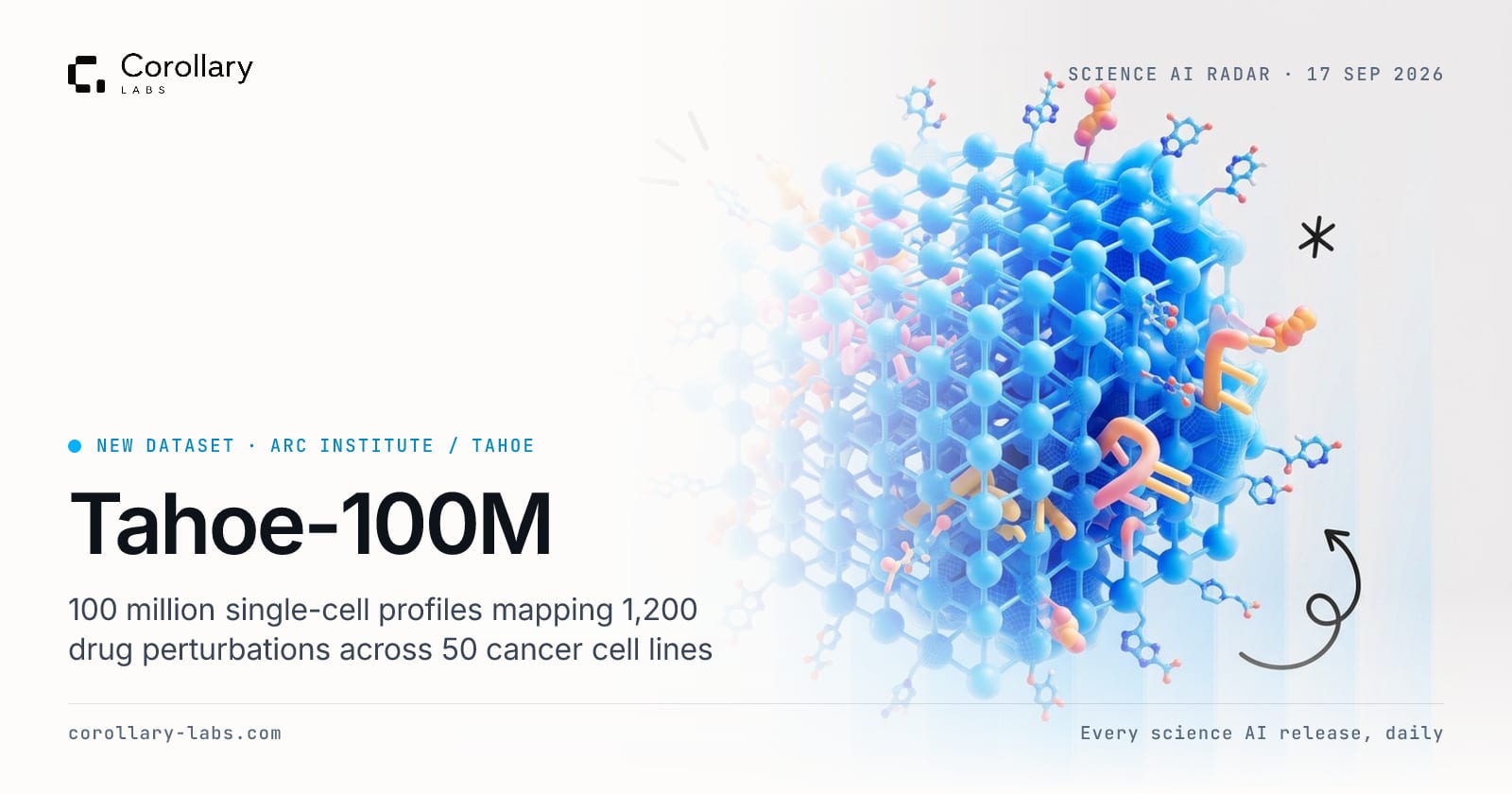
Tahoe-100M
100 million single-cell profiles mapping 1,200 drug perturbations across 50 cancer cell lines
· 7 claims checked against 2 sources
What it is
Tahoe-100M is a giga-scale single-cell perturbation dataset released by Arc Institute and Tahoe. It contains 100 million single-cell transcriptomic profiles measuring the response of 50 cancer cell lines to 1,200 drug perturbations, spanning roughly 60,000 drug-cell interaction combinations. It is the founding dataset of Arc Institute's new Virtual Cell Atlas.
How it works
The data was generated on Tahoe's Mosaic platform, which pools a highly diverse and optimally balanced 'cell village' of cancer lines into the same well. This design reduces batch effects and allows thousands of conditions to be profiled in parallel at single-cell resolution. Sample preparation ran through Parse Biosciences' GigaLab, and sequencing was performed by Ultima Genomics.
What is new
The authors describe Tahoe-100M as 50 times larger than all publicly available drug-perturbed single-cell data combined. It is paired with Arc's AI-curated scBaseCount, a repository of 200 million cells from 21 species, together forming a combined 300 million cell public resource under the Arc Virtual Cell Atlas. For groups building predictive models of cellular response to chemical perturbation, this offers training data at a scale that was not previously public, aimed at moving some drug-response questions from wet lab experiments toward computational queries.
Limits
The atlas is built entirely from cancer cell lines. How well models trained on it generalize to other tissue contexts, such as primary or non-cancerous cells, remains to be established.
Availability
Tahoe-100M is described in a preprint on bioRxiv. The dataset is open source and has been freely accessible via Arc Institute's Virtual Cell Atlas portal since February 25, 2025.
The evidence
Each statement above was written with the sentence from the source that supports it, and a program (not a model) checked that every quote and every figure appears in the pages it read. Here they are.
- 01
Tahoe-100M contains 100 million single-cell transcriptomic profiles measuring 1,200 drug perturbations across 50 cancer cell lines
“It includes 100 million cells and maps 60,000 drug-cell interactions, measuring cellular response across 50 cancer cell lines to 1,200 drug perturbations” S1
- 02
Tahoe-100M maps roughly 60,000 drug-cell interactions
“mapping 60,000 drug-cell interactions” S1
- 03
Tahoe-100M is 50x larger than all public drug-perturbed single-cell data combined
“Tahoe's Tahoe-100M, is the world's largest single-cell dataset, 50x larger than all public drug-perturbed data combined” S1
- 04
The dataset was generated using Tahoe's Mosaic platform with a diverse, balanced cell village design that reduces batch effects
“Our high-throughput Mosaic platform, composed of a highly diverse and optimally balanced "cell village", reduces batch effects and enables parallel profiling of thousands of conditions at single-cell resolution at an unprecedented scale” S2
- 05
Sample preparation used Parse Biosciences' GigaLab and sequencing was done by Ultima Genomics
“Generated using Tahoe's Mosaic platform, Tahoe-100M leveraged Parse Biosciences' GigaLab for single cell sample preparation and Ultima Genomics for sequencing” S1
- 06
Tahoe-100M is the founding dataset of the Arc Virtual Cell Atlas, paired with Arc's scBaseCount of 200 million cells from 21 species, for a combined 300 million cell resource
“Arc's scBaseCount is the first single-cell RNA sequencing data repository from public data to be curated and reprocessed at scale using AI agents. This gene expression data from another 200 million cells from 21 different species” S1
- 07
The dataset is open source and freely accessible via Arc's website as of February 25, 2025
“This data is open source and freely accessible via Arc's website as of February 25, 2025” S1
Sources
- S1Tahoe Open Sources Tahoe-100M, the World's Largest Single-Cell Dataset, as the Inaugural Contribution to Arc Institute's New Virtual Cell Atlas | Arc Institutearcinstitute.org/news/arc-vevo
- S2Tahoe-100M: A Giga-Scale Single-Cell Perturbation Atlas for Context-Dependent Gene Function and Cellular Modelingbiorxiv.org/content/10.1101/2025.02.20.639398v1